A high IQ can give you potential, but it doesn’t automatically teach you how to succeed in school.
Have you ever looked at a student who seems incredibly intelligent but consistently receives disappointing grades?
Maybe they can explain complicated ideas during a conversation. Maybe they ask unusually thoughtful questions, solve problems quickly, or remember information that everyone else seems to forget.
And yet, when the report card arrives, their grades don’t seem to match their abilities.
It can be confusing.
Students may start wondering, “If I’m actually smart, why am I struggling?”
Parents may wonder whether the student is lazy.
Teachers may assume the student isn’t trying hard enough.
But sometimes the real problem is much more complicated.
Academic performance isn’t determined by intelligence alone.
Intelligence Is Only One Piece of the Puzzle
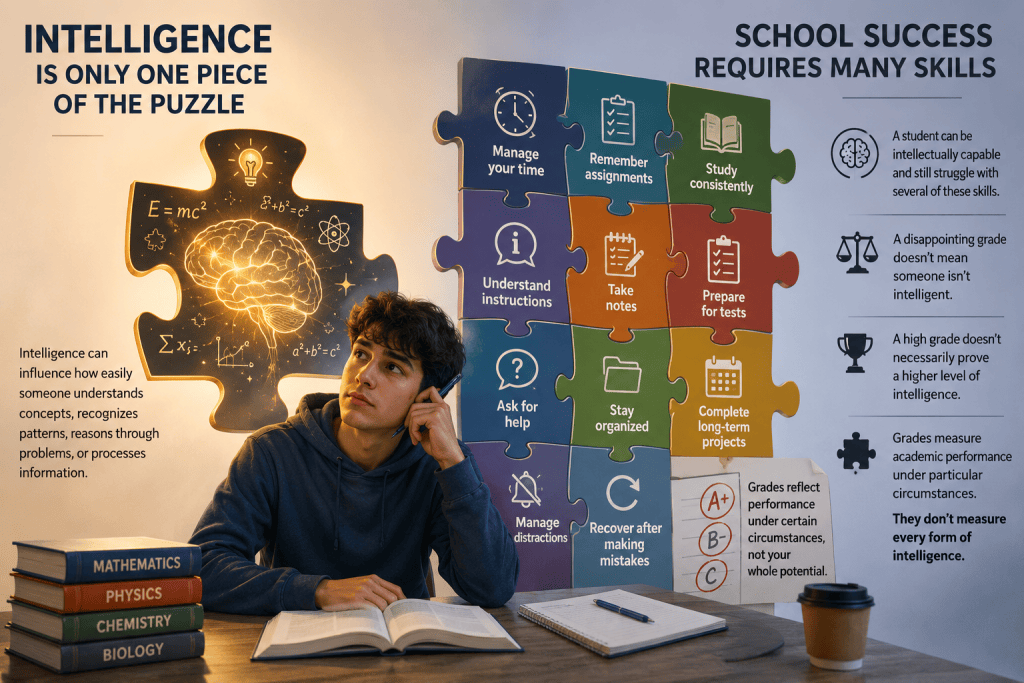
Intelligence can influence how easily someone understands certain concepts, recognizes patterns, reasons through problems, or processes information.
But school requires much more than understanding.
Students also need to:
- Manage their time
- Remember assignments
- Study consistently
- Understand instructions
- Take notes
- Prepare for tests
- Ask for help
- Stay organized
- Complete long-term projects
- Manage distractions
- Recover after making mistakes
A student can be intellectually capable and still struggle with several of these skills.
That’s why a disappointing grade shouldn’t automatically be interpreted as evidence that someone isn’t intelligent.
Likewise, a high grade doesn’t necessarily prove that someone has a higher level of intelligence.
Grades measure academic performance under particular circumstances. They don’t measure every form of intelligence a person can have.
The “Smart Student” Trap
There is another problem that doesn’t get discussed enough.
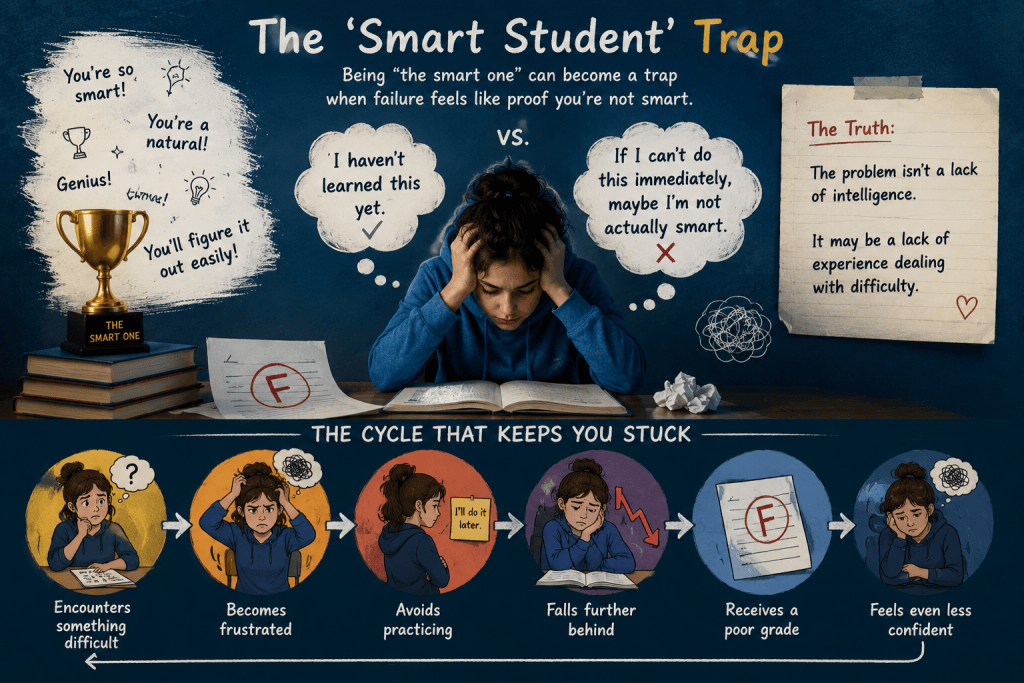
Students who are repeatedly told that they’re smart can sometimes develop an unhealthy relationship with failure.
If being “the smart one” becomes part of someone’s identity, struggling with something can feel embarrassing.
Instead of thinking:
“I haven’t learned this yet.”
They may think:
“If I can’t do this immediately, maybe I’m not actually smart.”
That mindset can create a surprising cycle.
The student encounters something difficult → becomes frustrated → avoids practicing → falls further behind → receives a poor grade → feels even less confident.
The problem isn’t necessarily a lack of intelligence.
It may be a lack of experience dealing with difficulty.
Effort Still Matters
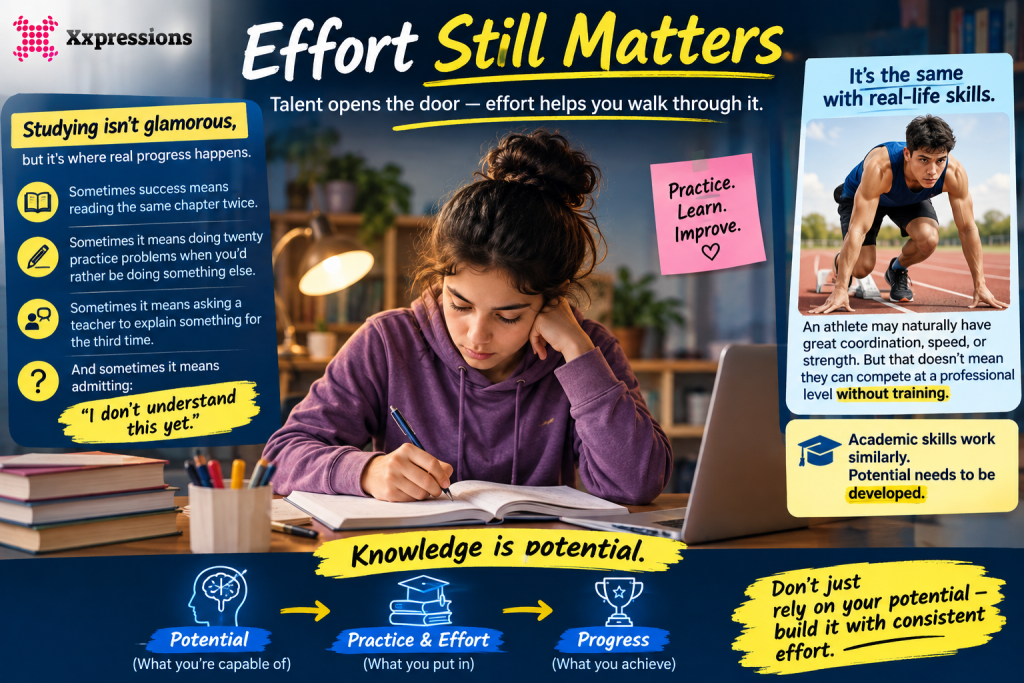
There is nothing particularly glamorous about studying.
Sometimes success means reading the same chapter twice.
Sometimes it means doing twenty practice problems when you’d rather be doing something else.
Sometimes it means asking a teacher to explain something for the third time.
And sometimes it means admitting:
“I don’t understand this yet.”
A high level of ability can make certain tasks easier, but ability doesn’t eliminate the need for practice.
Think about an athlete.
Someone might naturally have excellent coordination, speed, or strength. That doesn’t mean they can walk onto a professional field without training.
Academic skills work similarly.
Potential needs to be developed.
Your Study Method Might Be the Problem
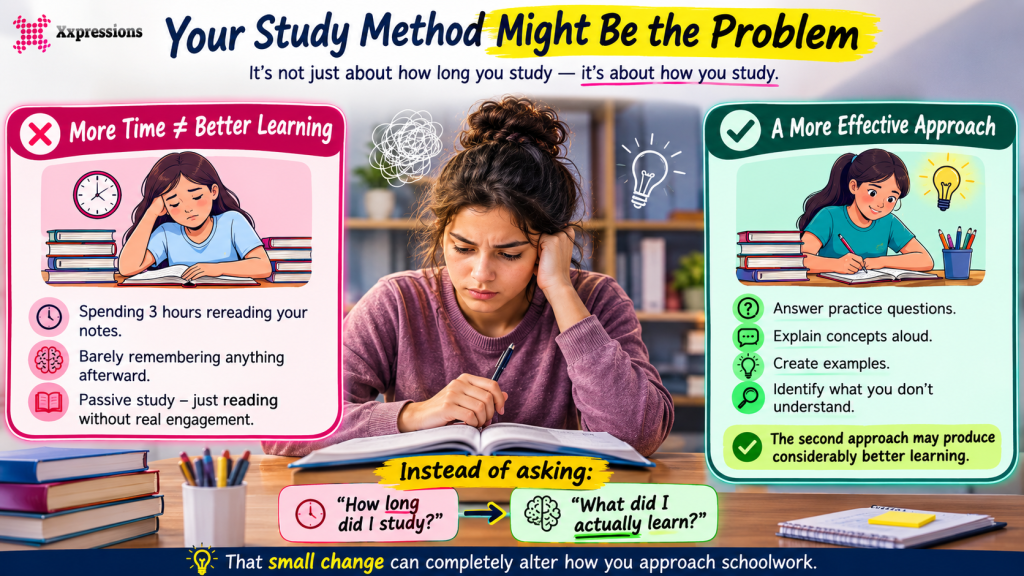
One of the easiest mistakes students make is assuming that studying means simply spending more time with a textbook.
But more time doesn’t always equal better learning.
Imagine spending three hours rereading your notes while barely remembering anything afterward.
Now compare that with one focused hour spent answering practice questions, explaining concepts aloud, creating examples, and identifying what you don’t understand.
The second approach may produce considerably better learning.
Instead of asking:
“How long did I study?”
try asking:
“What did I actually learn?”
That small change can completely alter how you approach schoolwork.
Stop Confusing Familiarity With Understanding
Here’s a common study trap.
You read a chapter.
Everything looks familiar.
You think:
“Yeah, I know this.”
Then the test arrives.
Suddenly, you can’t explain the concept without looking at your notes.
That’s because recognizing information isn’t the same as being able to retrieve or use it.
Instead of repeatedly rereading material, try closing the book and explaining the concept from memory.
Ask yourself:
- What are the three most important ideas?
- Could I explain this to someone younger than me?
- Can I create an example?
- What would happen if the teacher changed the question?
- What part of this topic still confuses me?
These questions force your brain to do more than recognize information.
They make you use it.
Organization Can Matter More Than Students Realize
Sometimes the biggest academic problem isn’t intelligence or even studying.
It’s organization.
A student may understand everything discussed in class but still lose points because:
- An assignment was forgotten
- A deadline was missed
- Instructions weren’t followed
- Notes are impossible to find
- A project was started the night before
- Test preparation began too late
These aren’t necessarily signs of low intelligence.
They are academic management problems.
And management skills can be learned.
A simple calendar, assignment tracker, reminder system, or weekly planning routine can sometimes make a bigger difference than another hour of studying.
What If You Understand the Material but Still Perform Poorly on Tests?
This is worth investigating.
Some students understand concepts during class but struggle when they’re placed under time pressure.
Others experience difficulty with reading-heavy questions, remembering instructions, organizing written responses, or filtering distractions.
A student may also know an answer but struggle to demonstrate that knowledge in the format required by a particular test.
If this happens repeatedly, don’t simply conclude:
“I’m bad at school.”
Instead, look for the specific point where the process breaks down.
Do you struggle with:
Understanding?
Then you may need different explanations or additional instruction.
Remembering?
You may need retrieval practice and spaced review.
Applying information?
You may need more practice with examples and unfamiliar questions.
Time management?
You may need a different testing strategy.
Organization?
You may need external systems and routines.
Finding the actual problem makes it much easier to find a useful solution.
Teachers Matter, Too
Students have responsibilities, but education isn’t a one-person process.
Teachers influence how information is presented, practiced, explained, and assessed.
A student who struggles with one teaching approach may perform dramatically differently when information is presented another way.
That doesn’t mean teachers are responsible for every poor grade.
It means that learning is an interaction between the student, the teaching environment, the material, and the strategies being used.
If you’re struggling, communicating with your teacher can be one of the most useful things you do.
Don’t simply say:
“I don’t understand.”
Try something more specific:
“I understand the first part, but I get lost when we start applying the formula.”
That’s information a teacher can actually use.
Don’t Build Your Identity Around a Number
Whether the number is an IQ score, GPA, test score, or class rank, be careful about turning a measurement into an identity.
You are not your GPA.
You are not your IQ score.
You are not your worst exam.
And you aren’t your best exam either.
Numbers can provide useful information, but they are not complete descriptions of a person.
A student who receives a low grade may need more practice.
They may need better strategies.
They may need additional support.
They may need a different explanation.
They may need to develop organization or time-management skills.
None of those possibilities automatically mean they aren’t intelligent.
The Better Question to Ask
Instead of asking:
“Am I smart enough to succeed?”
ask:
“What is preventing me from demonstrating what I know?”
That question is much more useful.
Maybe your study strategy isn’t working.
Maybe you’re procrastinating.
Maybe you’re overwhelmed.
Maybe you don’t understand the instructions.
Maybe you need more practice.
Maybe you’re learning the material but struggling to demonstrate it on tests.
Maybe you need to talk with your teacher.
Whatever the reason, identifying the obstacle gives you something you can work on.
And that’s an important lesson for students of every ability level:
Potential is not the destination. It’s the starting point.
A high IQ can be an advantage.
A high GPA can be an achievement.
But neither guarantees success.
The students who learn how to practice, adapt, organize themselves, ask for help, and keep going when something becomes difficult are building skills that matter far beyond the classroom.
So if your grades don’t seem to match your abilities, don’t immediately conclude that something is wrong with your intelligence.
Take a closer look.
The problem may not be how smart you are.
It may be how you’re being asked to learn.