Thoughts May Appear Automatically. Your Actions Are Still Your Choice.
Have you ever had a thought that made you stop and wonder, “What kind of person thinks something like that?”
Maybe it was an angry thought.
Maybe it was judgmental.
Maybe it was completely out of character for you.
Or perhaps you had a thought about another person that you would never actually say out loud.
If so, you’re not alone.
Human beings have thoughts constantly. Some are helpful, some are random, some are uncomfortable, and some don’t represent what we actually believe or value.
The important question isn’t always “Did I have the thought?”
Sometimes the more useful question is:
“What did I choose to do with it?”
Thoughts and Actions Aren’t the Same Thing

A thought is an internal experience.
An action is something you choose to do – or, in some cases, something you choose not to do.
That distinction matters.
You might think something unkind about someone without saying it.
You might feel angry without attacking anyone.
You might disagree with someone’s identity, beliefs, or lifestyle without treating that person disrespectfully.
You might even have an irrational or uncomfortable thought that disappears a few seconds later.
Having the thought doesn’t automatically mean you’ve endorsed it.
What matters is how you respond to it.
Do you examine it?
Do you challenge it?
Do you let it control your behavior?
Or do you recognize it as a thought and choose a different action?
That’s where personal responsibility becomes important.
Why Actions Matter So Much
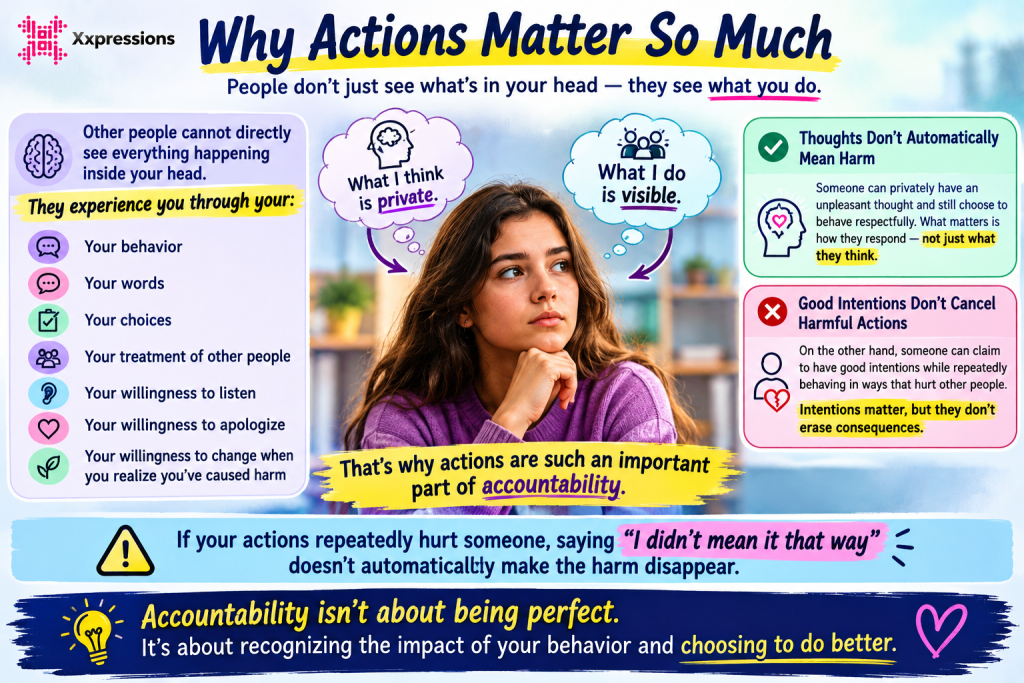
Other people cannot directly see everything happening inside your head.
They experience you through your behavior.
Your words.
Your choices.
Your treatment of other people.
Your willingness to listen.
Your willingness to apologize.
Your willingness to change when you realize you’ve caused harm.
That’s why actions are such an important part of accountability.
Someone can privately have an unpleasant thought and still choose to behave respectfully.
On the other hand, someone can claim to have good intentions while repeatedly behaving in ways that hurt other people.
Intentions matter, but they don’t erase consequences.
If your actions repeatedly hurt someone, saying “I didn’t mean it that way” doesn’t automatically make the harm disappear.
But Thoughts Still Matter
Saying that actions matter doesn’t mean thoughts are irrelevant.
Thoughts can influence behavior.
Imagine a teacher looking at a student’s artwork.
One thought might be:
“This is creative. I wonder what inspired them.”
That thought could lead to curiosity, encouragement, and a positive conversation.
Another thought might be:
“I don’t understand this at all. This isn’t very good.”
The teacher could respond very differently.
The artwork hasn’t changed.
The student hasn’t changed.
The internal interpretation has changed – and that can influence what happens next.
This is why learning to notice your thoughts can be valuable.
You don’t have to believe every thought you have.
And you don’t have to act on every emotion you experience.
You Are Allowed to Question Your Own Thinking
One of the most useful skills you can develop is the ability to pause before accepting a thought as truth.
Ask yourself:
- Why am I thinking this?
- Where did this belief come from?
- Do I have evidence for it?
- Could there be another explanation?
- Am I reacting to the person or to my assumptions about them?
- Would I behave differently if I knew more information?
- Is this thought consistent with the kind of person I want to be?
These questions don’t require you to shame yourself.
They encourage self-awareness.
And self-awareness gives you an opportunity to choose what happens next.
You Don’t Have to Be Perfect
There’s another trap worth avoiding.
Sometimes people become so focused on having “good” thoughts that they panic whenever an uncomfortable thought appears.
That’s not realistic.
You are going to experience anger.
You are going to experience jealousy.
You are going to misunderstand people.
You are occasionally going to make unfair assumptions.
You may even think something that conflicts with your own values.
Being a thoughtful person doesn’t mean never having an unpleasant thought.
It means being willing to examine your thoughts instead of automatically allowing them to control your behavior.
Growth doesn’t require perfection.
It requires awareness.
When Thoughts Become a Problem
There are situations where repeatedly thinking about something can influence how you behave.
If you constantly reinforce a negative assumption about a particular person or group, for example, that assumption can become easier to act upon.
That’s why challenging harmful beliefs can be worthwhile even when nobody else can see your thoughts.
You aren’t doing it simply to appear like a good person.
You’re doing it because your internal habits can shape your future choices.
A thought may not define you, but repeatedly nurturing a belief can influence the person you become.
That’s why reflection matters.
Accountability Doesn’t Mean Self-Hatred
Making a mistake doesn’t mean you’re a terrible person.
But refusing to acknowledge the mistake can become a problem.
There’s a major difference between:
“I did something harmful, so I must be a horrible person.”
and:
“I did something harmful, and I need to understand what happened and do better.”
The second response is much more productive.
Shame often makes people defensive.
Accountability gives people an opportunity to change.
If you hurt someone, listen.
If you were wrong, acknowledge it.
If your behavior came from an unfair assumption, examine that assumption.
If necessary, apologize and change what you do next time.
That’s what growth looks like.
Your Choices Tell a Story
You don’t have complete control over every thought or emotion that appears in your mind.
You do, however, have opportunities to decide how you respond.
You can pause instead of reacting.
You can ask questions instead of assuming.
You can listen instead of dismissing.
You can apologize instead of becoming defensive.
You can choose kindness even when you’re angry.
And you can recognize an unhealthy thought without turning it into harmful behavior.
That’s an important distinction:
You are not every thought that crosses your mind.
But your repeated choices can tell people – and eventually yourself – a lot about who you are becoming.
The Goal Isn’t Perfect Thoughts
Maybe the goal isn’t to eliminate every negative thought.
Maybe the goal is to become better at noticing them.
Notice the thought.
Question it.
Understand where it came from.
Decide whether it reflects your values.
Then choose your response.
Your thoughts are part of your inner world.
Your actions are part of the world everyone else experiences.
Both deserve attention – but they aren’t the same thing.
So the next time you have a thought that makes you uncomfortable, don’t immediately conclude that it defines you.
Pause.
Ask yourself what the thought is telling you.
Then ask the more important question:
“What am I going to do with it?”
Because thoughts can appear without permission.
Your actions are where your choices become visible.